





Dogs
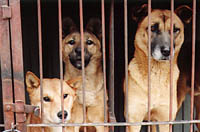 Since the Korean government's Ministry of Agriculture defines dogs and cats as pets and not livestock, many Koreans excuse their choice to eat dog by citing cultural pride and tradition. Some of these dog meat proponents claim that eating dogs enhances virility.
IAKA believes however, as do many Koreans, that true tradition of eating dogs gained prevalence after the Korean War as a result of widespread starvation. Dog as a delicacy grew in popularity after reconstruction because dog dealers and restaurants began to fabricate health benefits derived from eating dog meat.
In reality, the dog meat trade has more to do with greed and profits rather than any sort of tradition. The practice has unfortunately spread to younger Koreans who did not live through the war and believe without question the myths passed down by some elders. In addition, some youth eat dog meat in defiance of animal welfare campaigns, viewing these groups as western imperialists.
The truth is that every year, more than 2 million dogs are killed and consumed in South Korea. With each dog fetching the equivalent of US $250, it is a lucrative industry protected by powerful corporate interests. Killing and eating dogs is illegal in South Korea. Enforcing these laws amidst powerful lobbyists and government officials who eat dog meat is a difficult proposition.
These photographs show how much dogs suffer for the misinformed, willingly ignorant practice of eating dog meat. They are not suitable for all audiences. Viewer discretion is advised.